How To Use A Light & Pistol
Over the years several different techniques have come and remained. Now there are a few of these that I personally think are stupid and I truly feel like only two are necessary flashlight techniques but I’ll discuss that later on.
Of the more common ones to discuss we have: The FBI Technique, The Neck Index, The Harries Technique, The Surefire/Rogers Technique (These are effectively the same thing but some disciplines differentiate the two), and The Chapman Technique. This list is virtually a complete list of the typical light and weapon approaches, though you will occasionally find some odd ball way of doing it especially now with improvements in flashlight design.
The FBI Technique

Let’s go ahead and just get rid of a few off the top that again I think are ridiculous and tactically foolish let me explain. The FBI Technique raises the non dominant hand up above the head to cast light over the area and illuminate the weapon and sights.
The theory perpetuated by those who support this technique is that the shooter will aim at the light and not hit you since they will be shooting up towards your hand. Allow me to retort…
- When we make the decision to carry a gun we accept increased danger and responsibility in our lives as protectors. That isn’t to say we should make foolish tactical mistakes but it is to say you shouldn’t make foolish mistakes in the name of not being placed in harms way. It is tactically foolish to clear ones own house though we sometimes accept that responsibility as the protector of our family.
- Anyone that thinks you can effectively fire at a 500-1000 lumen light in the dark has never attempted that feat. Could you hit them? Sure but it would have more to do with luck than skill which is a resource available no matter which technique you use. Grab an airsoft pistol and a light and shine it in your spouses eyes one night and ask them to try and shoot at you.
- The fatal flaw in the FBI technique is that around 90% of the world is right handed, and most shooters miss low and to the left. Which means if someone does happen to be able to aim at your light the misses (around 72% likelihood they will miss) being low and to the left allow them to inadvertently make a canoe rack in your skull.
Often times in conversation someone will retort that the FBI uses this technique and therefore it is the gold standard. In truth I know of not one respected tactical shooter that uses this technique including the FBI. I’m unsure if they still teach it at their academy but it is certainly not valued in the field.
Beyond that the original intent of the technique was to cast light further from a lantern and it was needed to illumine sights as tritium was not discovered until 1934. Proceeding that we have the invention of flashlights but remember that the original Mag Lights we used as kids cast such little light they were less than your current cellular phone light.
The simple fact is that flashlight technology has advanced so much since the early 2000’s that even if there were an argument for this method prior to development of modern LED lights there certainly isn’t one now.
Neck Index

Far be it from me to call this one stupid and argue with the grandfather of modern defensive pistol, Col Jeff Cooper. However, I will respectfully disagree with the validity of this technique and I will illustrate why.
This method locates the light next to your neck or temple depending on which school you learned it from. Holding the light like a club you control the tailcap switch while illuminating your sights and the target. The theory being that it naturally tracks where you want to look.
Locating the light directly on your neck always seems to be a bit awkward and not intuitive so I tend to do a modified version with the light floating up towards my left ear but let me clarify the use of this technique.
When searching an area a very intuitive and effective defense posture is having the light up over your shoulder by your left ear. This leaves the light in a striking motion and allows good control that tends to intuitively move where you want it go.
The reason I suggest practicing this technique with a pistol is that you may not have adequate time in a defensive engagement to draw your firearm and change to a more secure position to control both objects, and since this method searches well and is intuitive without a weapon it has practical benefit to train and practice.
The downsides to it are two fold: 1st when holding two objects it tends to lose some of its intuitiveness and becomes an additional task that you have to focus on or train enough that it is muscle memory. 2nd it only affords one hadn’t support of the pistol slowing followup shots and tracking of targets substantially.
The Harries Technique


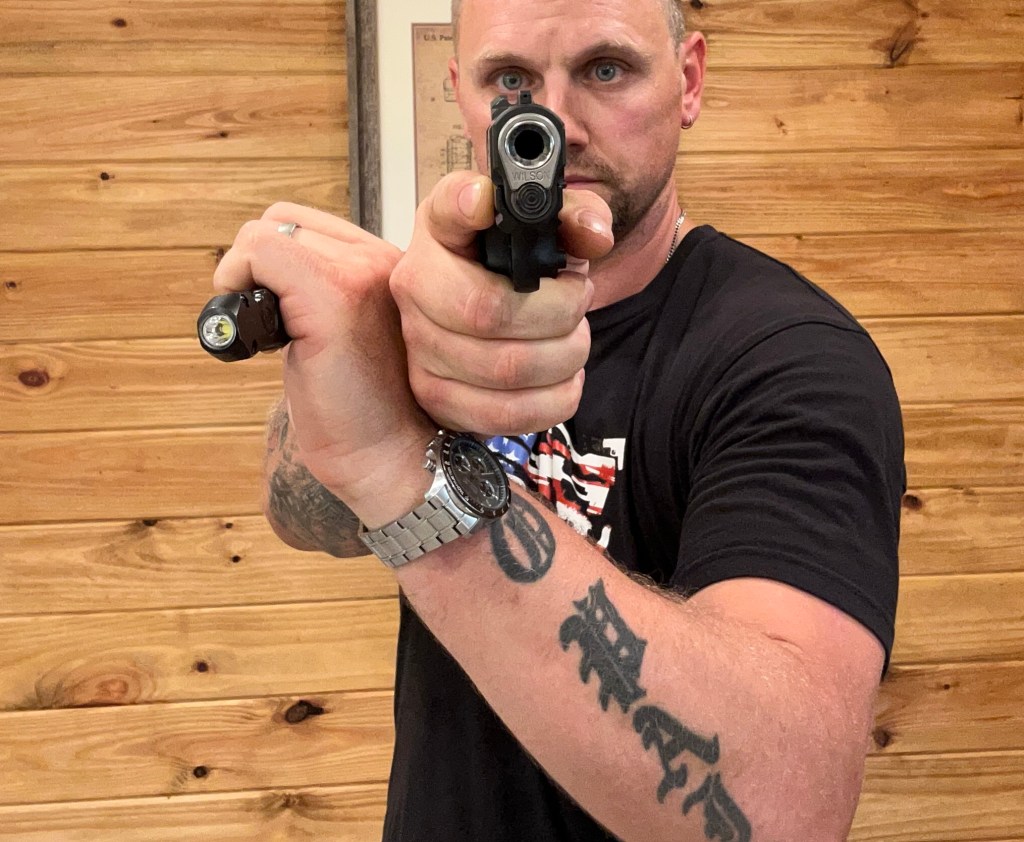
This one should come as no surprise being the technique of choice for every action movie since the 80’s. Though I do not believe this to be the most pragmatic approach in our lexicon of flashlight/weapon techniques and it tends to be a bit banal but it is still my go to for a few reasons.
- it affords a reasonable support grip on the firearm to better control target acquisition and faster followup shots.
- It tends to be a very natural position and is relatively intuitive for most shooters.
- It lends itself well to tailcap activated lights which are becoming more and more common in our EDC (Ever Day Carry).
The basic technique is to cross your support hand underneath your firing hand with the backs of the hands touching. Though some modifications have been done with wrists resting on one another particularly for someone like me with wrist injuries that struggles to make the backs of my hands touch without causing pain.
The Surefire/Rogers Technique

Someone is bound to get mad at me for comparing these two but the similarities found in these and the Massad Ayoob Technique mean that we basically have one main technique with 3 alternates that don’t tend to change the fundamentals.
Certain lights with a hold ring (Surefire makes an aftermarket attachment to purchase) are designed specifically for those technique and it works reasonably well with both lights whether tailcap activated or a side switch.
The biggest benefit here is that it allows the best overall support hand grip since you are actually gripping the firearm as well as the light and it works regardless of which light you carrying.
The basic principle here is that you pinch the light between your index and middle finger and wrap your hand around the gun in a manner that allows you to activate the controls.
The downside I have found is that it takes a lot more practice to make the transition and tends to be a bit awkward especially for newer shooters. No matter what light I use I always find this to be a bit uncomfortable and clunky which is why I don’t practice it.
Chapman Technique


Finally, we have the Chapman technique which has similar benefits to the Surefire method as it just alters the hold on the light so it is held like a hammer and and again wraps the pistol and light in one grip. Again this affords support hand control of the weapon.
This tends to be slightly less awkward than the Surefire method and works better with side mount controls on the light and is less effective with tailcap controls.
This is actually one of my favorites and next to Harries Technique is the one I use the most.
Which Should You Use
I generally recommend students learn and master two techniques because there doesn’t seem to be one that works well with all lights. I tend to use Harries for tailcap lights and Chapmans for side mount controls. My current and favorite EDC light is a Streamlight Wedge which has side controls and is very thin which works well with Chapmans method.
Again I think everyone should train with the neck index to some extent because of its usefulness in transition from light only to a quick few shots at an incoming threat. And I see no use for the FBI Technique as an antiquated and tactically foolish option.
If I was starting my career over and going to learn two techniques to use for everything I would focus on Chapmans and Surefire with a little practice on Neck Index.

 Timberline Security Solutions
Leave a comment