
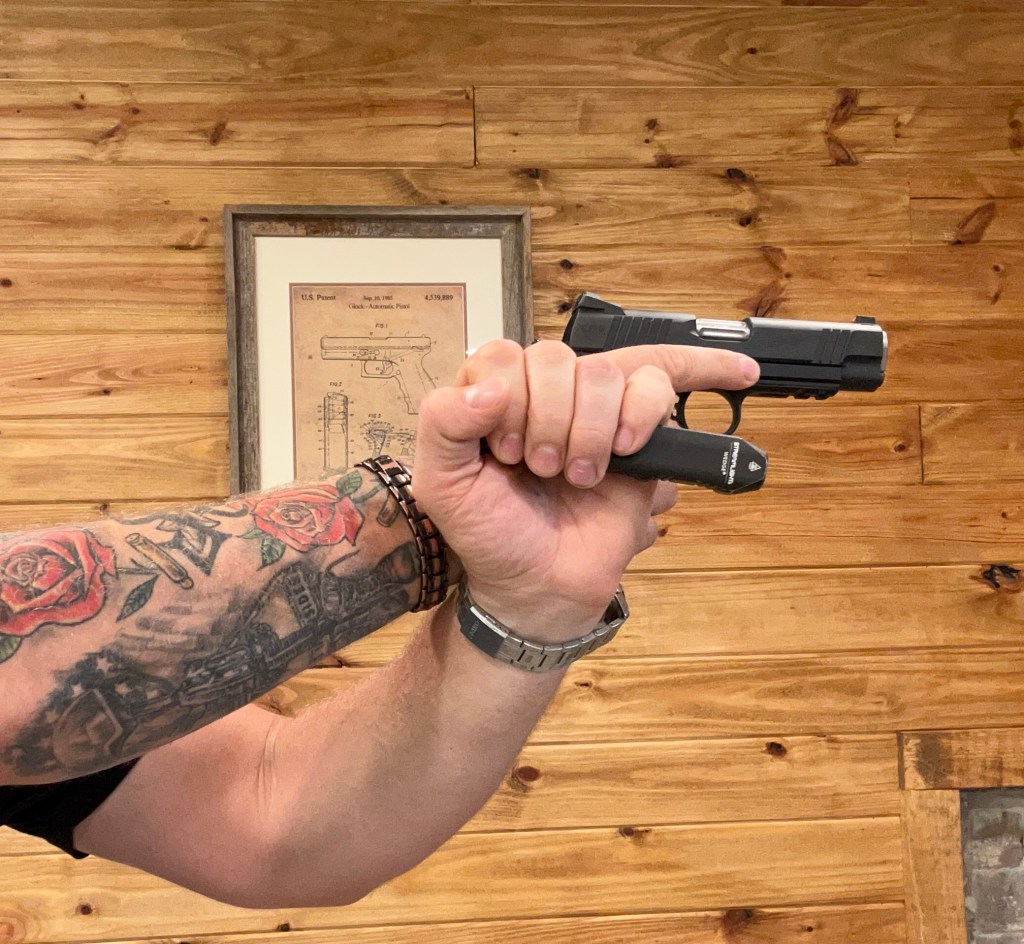
Pistol or Rifle Which Setup And Light is Best.
Weapon lights are an interesting component of both pistols and rifles. As a general rule all my (completed) rifles have weapon lights. There’s simply no reason not to have one on them if the weapon is intended to be used in a tactical or defensive setup. Simply put, my lever actions may not have one but EVERY AR15 has one.
When it comes to pistols the real reason for having a pistol is because they are compact, otherwise we would just use rifles everywhere because they are far more capable and generally faster (with some exceptions for CQB). However, when we add a light to the pistol, we negatively impact its effectiveness as a compact defensive tool.
Does that mean we shouldn’t have one on pistols? No. But it also doesn’t mean that we should have one on our pistols. To venture into this topic we have to first understand a few things about lights.
Lumens
Lumens are simply the amount of light measured to the human eye. If that light cannot be seen it effectively has a lumen count of 0. For defensive light 500-1000 lumens seems to be adequate for for both pistols and rifles. A common misconception is that a light with 1000 lumens will blow away a light with 500. It has twice the lumens!
However, in practicality the far more important component of the light is the amount of candela the light has, more on this in a minute. Finally, you will sometimes see Lux which is simply lumens per square meter and must be rated at consistent distances. Truthfully, I have found Lux measurements to be unhelpful and unnecessary.
The bottom line here is that if the light is between 500-1000 lumens it is an adequate lumen for self defense, rifle use or EDC. However, if you’re reading this article ten years down the road this may no longer be true and we may develop lights at 100,000 lumens or 1 lumen that works. Who knows what is going to happen with technology (this is an exaggeration guys). But today 500-1000 is a solid starting point.
Candela
Technically 1 candela is the light intensity of one candle but candela is simply just the focus of the light. A laser beam has a really high candela while an old lantern would have a relatively low candela.
Candela and Lumens (and Lux) relate similar to horsepower and torque. You can have medium HP and high torque, you can have medium torque and high HP, but you really cant get to high torque with low HP or vice versa. In other words there’s not necessarily a direct correlation but you can’t have one without the other and they certainly have a relationship that respond to one another.
The science of lasers and lights is a deeply mathematical and physics related topic that I won’t pretend to be an expert on and if you want more detail Google it from someone smarter than me. But this basic understanding will give you what you need to understand weapon lights.
The minimum candela I use on a weapon mounted light is around 5,000 and ideally I want to be up closer to 15,000-20,000 for pistols. 20,000 for CQB rifles is adequate but for a mountain rifle terrain rifle or recce rifle setup I would opt for something as high as 100,000 candela.
Pistol Lights
When it comes to pistols, the Surefire X300 seems to be the gold standard that everything is compared to and has become the Glock 19 of lights. It is big, clunky but works and fires. It produces around 11,000 candela at 1000 lumens producing a beam intense enough you can’t stare back at it, and it will penetrate photonic barriers (fog, mist, other light, etc.)
The Streamlight TLR1 HL is another 1000 lumen light and throws around 20,000 candela. If the X300 is the Glock 19 this light is certainly the Sig 320 to it. Truthfully I own both and prefer the TLR1 HL as I tend to find it more robust, and the beam is certainly more intense with an extra 8,000 candela. But either are fine lights.
If you desire smaller lights options like the TLR8, 7, and 7 Sub are options providing less intense light and candela in a smaller package. But the bigger question to ask is do you need a light at all on smaller pistols?
When it comes to a tac rig or outside the waist band carry, I generally prefer a light because the added bulk and weight doesn’t seem to affect as much. Inside the waistband I find to be a bit of a bear to add a light and I typically don’t have on with a few exceptions. In the past I have added TLR6’s to some smaller sub compact guns but ultimately I have removed them since it negates the benefit of a subcompact gun to add a light.
Ultimately I do not live or die by the weapon light and if convenient, I will use it but my daily carry gun does not have one permanently fixed to it. I practice often with a flashlight and weapon combo which even if carrying a weapon light does not alleviate you of the responsibility to carry and practice with a handheld light. You may not be fighting with your ideal setup or even your gun, your battery may be dead, or the light might break. Not to mention searching for your car keys in the Walmart parking lot with a weapon mounted light is not advisable.
Weapon Lights On Rifles
This tends to be where the rubber meets the road and has a lot more variables to consider and some mounting options to discuss. First choose an adequate light for your rifle and all tactical rifles and shotguns should be setup with a light.
For shotguns, a high quality pistol light again with around 1000 lumens and 15,000 candela works really well since distances are similar. However, with rifles we have to consider illuminating things at distance and having the brighter lights is far more important.
I remember once in Afghanistan searching a package we suspected to be an IED. Any bomb support was hours away and we didn’t have the tools (or expertise) to dismantle the potential bomb. Had I been there years prior, we would have had permission to detonated it with some form of ordnance but at this time we were told to wait for RCP (Route Clearance Patrol).
We were able to use our ACOG optics and the weapon lights to scan the IED from a distance to determine if any wires were coming out of it, did it still look suspicious up close, and were there any targeting identification points near it. We cleared it, took the risk and drove on with our mission.
Had we not had lights with enough candela to reach those distances we wouldn’t have been able to effectively view the potential IED and clear it. The candela rating needs to match the optic you build the rifle. If you have a zoom lens of any type than having a higher candela rating is certainly a valid concern.
Too Much Light
Having too much light can in some instances be problematic in theory but I have never found it to be true in real life. The theory is that once your eyes have adjusted to the night the light can be blinding in enclosed spaces especially with white washed walls.
This argument is virtually inconceivable for pistol lights since they are just not bright enough but even for rifles, I have personally never found this to be the case.
Installation Of Weapon Mounted Lights
It should go without saying that the lights need to be properly mounted but from an instructors standpoint it is amazing how many students screw this up.
- Ensure all your screws are actually set with a heat resistant thread locking compound. I personally use rockset but there are plenty of other options. If it isn’t heat resistant you will burn it off in a class because lights being placed near the barrel tend to absorb a lot of heat.
- Though some schools teach using lever release lights, I prefer to use a torque wrench with rockset to properly secure the light to the rail.
- This is a skill learned in the military that civilians and police rarely use. But take a piece of 550 cord and remove the inside string. Using the green outside string attach all of your devices (optics, lasers, lights. etc) to the firearm with solid secure knots and then burn the nots with a lighter so they have to be cutoff rather than untied. Doing this ensures even if it ever comes loose you will retain the device.
- Using tape or zip ties secure the cable from the pressure switch so it doesn’t get snagged when the rifle is slung or moved through tight areas.
- Protect the light from heat. Often firearms have a heat shield that does not protect the bottom of the barrel in which case the 6 o’clock position can get hot enough to damage the light or cook off the thread locking compound.
Following these protocols will virtually eliminate any risk of losing not only the light but any high dollar item attached to your weapon platform of choice.
Which Side To Mount The Light On?
Looking down the end of the barrel 12 o’clock being on top I recommend aligning the light anywhere from 2 o’clock to 10 o’clock. Lights on top tend to get in the way of optics and certainly iron sights.
The bottom 6 o’clock position I avoid because it makes for awkward positions when shooting from a barricade. Typically I set my light around the 2 – 3 o’clock position and sometimes to the 4 (reverse for left handed shooters). My pressure switch rests on top at approximately the 12 o’clock position, sometimes adjusted for a IR laser so that I can activate it with a C clamp grip.
I’ve seen shooters that mount it forward of their support hand on the support hand side of the rifle so as to be able to press the tail cap with their thumb. This is common among temporary on tail caps but has simply never been a method I found comfortable. Additionally, I don’t like holding tail cap switches when guns are recoiling because it tends to be more difficult to control.
I see methods like this often for people that train a lot but not from people that have spent much time in direct action simply because it’s an easy fundamental to train but much harder to employ in real life engagements when your adrenaline is rushing.
Pick one and train with it but keep all your rifles setup the same way so the grip and feel of each is identical. Also be cognizant of the lights shadow and understand it. I have a rifle that I need to file the SBR tax stamp on and shorten the barrel because the barrel creates a shadow that blocks a large portion of my field of view.

 Timberline Security Solutions
Leave a comment