
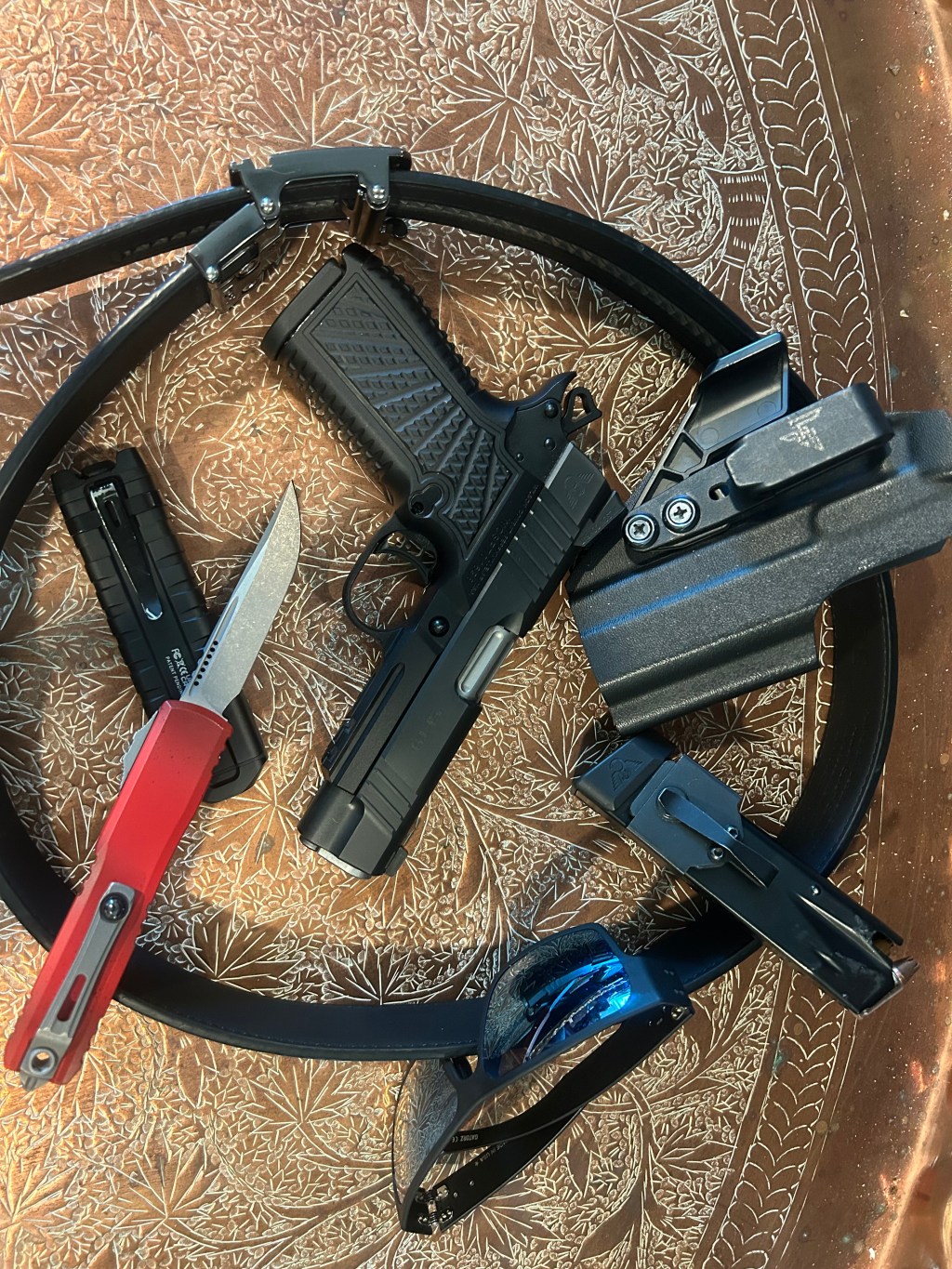
As a full-time trainer, I see a lot of students roll through classes with subpar gear. It runs the gamut—from people showing up without holsters or using 90’s-era cloth ones to those sporting the latest $250 “John Wick” holster. They inevitably arrive at class (ignoring the required equipment list) with a cheap holster, a cheaper gun, no spare magazines, and a belt that simply cannot support the weight and girth of the full-size 1911 they elected to bring.
Let’s dive into the essential equipment you need to attend a class—gear that also happens to be the same equipment required for successful concealed carry.
Foundational Equipment
There are a few items we need to select right off the bat. Opinions abound online, and while many instructors will tell you what to look for, they’ll often hesitate to recommend specific products. I’m approaching this differently: I’ll give you the exact products I use daily—and why. I have no affiliation with these companies and paid for everything myself. I won’t make a penny if you decide to buy them. These are simply products I believe in.
You’ll need a quality gun belt, a holster, and a pistol. After that, we can look at spare magazines, magazine carriers, knives, and flashlights. The truth is, your gear will evolve over time, and new products will eventually make older ones obsolete. When that happens, don’t be afraid to upgrade or adjust your opinions.
The first three go hand-in-hand: the day you buy your pistol, you should buy a holster and gun belt simultaneously. This is why I recommend budgeting two to three times the cost of your pistol as your total investment. You need gear, ammunition, and training (not a shameless plug—whether it’s from our company, TSSAlabama.com, or another, training is non-negotiable).
Gun Belts
Department store belts are inadequate and won’t support the weight of a loaded (or even unloaded) pistol. The weight can range from 13.5 ounces (e.g., a Smith & Wesson Airweight) to nearly 50 ounces for something like a CZ Shadow or a full-size 1911. A cloth or leather belt not designed to distribute that weight will be uncomfortable at best—and dangerous at worst—as the gun flops around.
Companies like The Beltman make excellent gun belts using rigid leather or plastic liners sandwiched between exterior materials to properly support the load.
Personally, I use Kore Essentials belts. They allow for ¼-inch adjustments, which is especially beneficial for appendix carry. I don’t favor models that use hook-and-loop fabric—they just don’t hold up long-term.
BLUF (Bottom Line Up Front): Buy two quality gun belts—one for everyday wear and one for more formal attire.
Holsters
This is one of the biggest problem areas I see—so let’s end the debate right here. You need a quality, fitted holster.
Cloth holsters are outdated, slow, and not durable enough for daily carry. They collapse when the gun is removed, making training a nightmare. They often use snaps for retention—hard to defeat when calm, let alone under stress. Avoid them entirely.
Leather holsters have similar issues with collapsing, but quality ones can still be a decent option—particularly for outside-the-waistband (OWB) carry. They rely on friction for retention and are still viable, though less common than plastic/resin holsters.
Leather holsters should never be used with firearms that lack a manual safety. It’s too easy for a flap or edge to fold into the trigger guard during re-holstering and cause a discharge.
Plastic/Kydex holsters (often resin or thermoplastics) are, in my opinion, the gold standard. They can be bought with active (button) or passive (friction) retention and are designed never to collapse. Whether OWB, IWB (inside waistband), or AIWB (appendix), these holsters come in almost unlimited configurations.
They’re often viewed as uncomfortable—but are they really? I used to think so, too, until I tried one. Now, I’d never go back. Because they’re custom-molded and thin, I actually find them more comfortable. They support the gun better, reducing fatigue over long periods of carry.
Holster fatigue is real. People often love their pistol/holster setup—until two weeks later when they’re back to pocket-carrying a tiny pistol because their hip hurts. Cheap plastic options are often better than high-end leather, but that doesn’t mean you should go too cheap—or too expensive. Once you hit around $60, you hit diminishing returns.
I recommend:
- Bravo Concealment – Best bang for your buck.
- C&G Holsters – Slightly higher quality, but more expensive.
- G-Code – My go-to for tactical rigs.
For more obscure pistols (e.g., Steyr, Wilson Combat, H&K), you may be forced to buy more expensive holsters due to limited availability.
One final note: leather/Kydex hybrids (popularized by Crossbreed) are better than all-leather models, but in my experience, they’re less comfortable than all-Kydex.
BLUF: Never use cloth. Leather is okay. Plastic/Kydex is superior and widely available.
Guns
We won’t go deep into pistol selection here—it would take a book. But if you’re starting out, keep these considerations in mind:
- Stick to common models. Exotic guns may be excellent but lack support (holsters, parts, magazines).
- Consider size and ergonomics. The Glock 19 used to be the gold standard, but more compact models like the Glock 43X or Sig P365 offer better concealment and similar performance.
- Carry what you’ll actually carry. A P365 in your pocket beats a P30L in your safe.
- Avoid guns that are hard to shoot. The Ruger LCP is a great example—it’s fine until you need to make precision shots or reload under stress.
My top 3 carry guns:
- Wilson Combat SFT/SFX9 – My favorite.
- H&K VP9K – Travel-friendly option over my more expensive Wilson Combat.
- Sig Sauer P365X Macro – Compact and versatile. My wife carries this as well and we gain the advantage of interchangeability with parts, magazines and holsters.
Over the years, I’ve carried just about everything—Glocks, M&Ps, Wilsons, Sigs. All are good. But I carry the one I shoot best—and that’s the SFT9. Skill with your weapon outweighs marginal differences in size or capacity.
Additional Equipment – Flashlights
I’m certified by Massad Ayoob Group to teach Lethal Force. As he puts it, we don’t teach “the law”—we teach rules of engagement.
If you’re carrying a firearm, you must also carry a flashlight. No exceptions.
You cannot pull the trigger without positive identification (PID) of your target. Daytime makes this easier (relatively), but stress changes everything. Students routinely make mistakes under stress—in broad daylight. Add low light to the equation and things get exponentially worse.
Yes, even in broad daylight, power outages, storms, or dead batteries can leave you in the dark. You need to be able to see.
Massad carries two flashlights. I usually carry one, with a spare in my backpack.
Some quick tips:
- One light with a USB charger, another with disposable CR123 batteries offers versatility.
- Tail-cap switches are common, but side buttons are often better for firearm use (see my article in Armed Lifestyle Magazine, Aug. 2025).
- Brands: SureFire is great but expensive. Streamlight, 5.11, Nitecore, Modlite, and O-Light offer solid budget options—just research the specific model because some of them are simply not reliable.
My go-to: 5.11 Deploy—cheap, reliable, and bright.
Lumens vs. Candela: Most manufacturers only promote lumens, but candela matters too. A 500-lumen light with 5,000 candela outperforms a 750-lumen light with 1,200 candela in real-world use. This goes in to breaking through photonic barriers. Have you ever tried to shine a light from the sunny exterior into a dark room and the light won’t penetrate? That’s the photonic barrier.
BLUF: Look for 500–1000 lumens with candela of 1,200–5,000.
Additional Equipment – Spare Magazines
This is debated, but here’s the short version:
- Some preach the 3-3-3 rule: 3 yards, 3 seconds, 3 shots. But this lacks hard data and is likely oversimplified.
- There are numerous real-world examples of civilians needing more than one mag—or suffering from a mag failure. It’s not the most common malfunction, but it’s common enough.
- Practical concerns matter, too. There’s only so much gear you can carry daily before it becomes excessive.
Do I carry a spare mag?
- Daily errands: Usually not.
- Security work or city trips: Yes.
- In class: Absolutely. Bring at least two spare magazines.
We’ll dive deeper into this in our upcoming book, but for now, here’s the takeaway:
Train how you carry. If you pocket-carry your spare mag, train that way. Don’t show up in battle belts unless you wear one professionally.
 Timberline Security Solutions
Leave a comment